DIY vs Hiring a Handyman: When Does It Stop Making Sense?
The Appeal of DIY Is Real — Until It Isn't
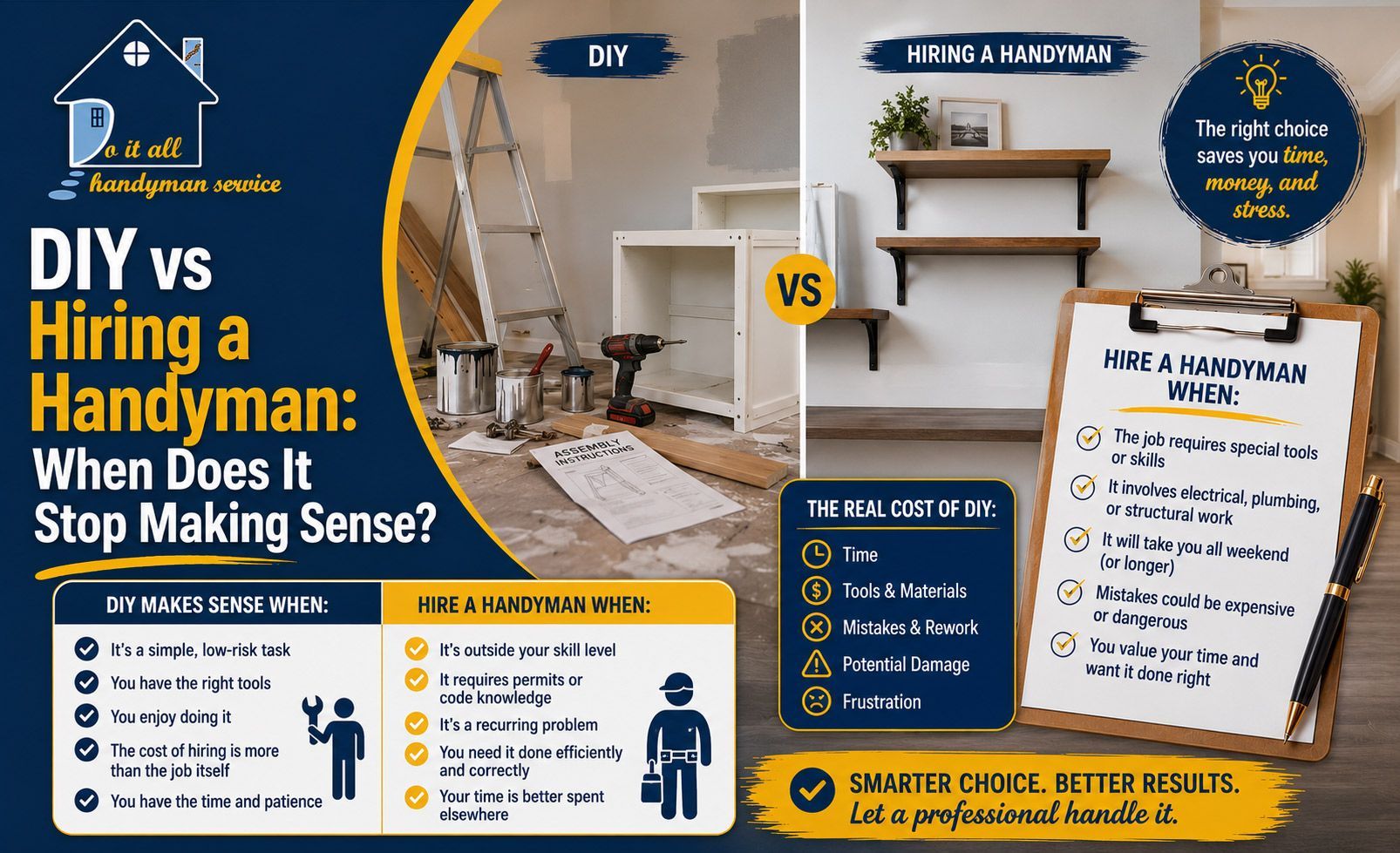
There's a genuine case for handling home repairs yourself. You save on labor, you learn how things work, and there's real satisfaction in fixing something with your own hands. For a wide range of tasks, DIY is the right call — efficient, cost-effective, and perfectly within reach of a homeowner with basic tools and some patience.
But there's a line. A point where a project's hidden complexity, the consequence of getting it wrong, or the time required tips the balance decisively toward hiring a professional. That line is rarely obvious from the outside looking in — and overestimating what a project involves is one of the most common and expensive mistakes homeowners make. In River Falls, WI, where homes range from early craftsman-era construction to recent builds, the right answer depends heavily on the specific project type and what your particular home is hiding inside its walls.
Where DIY Genuinely Makes Sense
A real category of home maintenance work is well within reach of a capable homeowner. These are jobs where the cost of a mistake is low, the technique is genuinely learnable, and the materials are inexpensive enough that starting over doesn't hurt much.
- Painting interior walls and trim — when surface prep is done correctly before the brush touches the wall
- Replacing light fixtures and ceiling fans — when the circuit is switched off and confirmed dead at the fixture
- Installing door hardware, locksets, and hinges — straightforward mechanical work with clear instructions
- Caulking around tubs, showers, and sinks — learnable technique, easy to redo if the first attempt isn't clean
- Replacing toilet internals — fill valves, flappers, and flush handles are designed to be homeowner-replaceable
- Basic landscaping, garden maintenance, and mulching
- Assembling flat-pack furniture and mounting shelving on studs or with appropriate anchors
What these projects share is that they're reversible, they don't require permits, and they don't touch structural or mechanical systems. A shelf that's slightly off-level gets re-hung. Caulk that looks rough gets cut out and redone. The stakes are low and the feedback loop is forgiving. Confidence earned on jobs like these is real — it just doesn't transfer automatically to projects in a different category.
Where the Line Starts to Shift
The calculation changes when a project involves structural work, mechanical systems, permits, or meaningful safety consequences. In River Falls, WI, where older homes frequently have aging electrical, original plumbing, and framing that predates modern standards, DIY work that opens walls or touches systems carries risk that isn't always apparent from the surface.
Electrical Work
Replacing a switch or outlet is accessible for most homeowners. Pulling a new circuit, adding a subpanel, upgrading a service entrance, or working around knob-and-tube wiring is not. Errors in this category range from nuisances — a tripped breaker — to genuine hazards like a wiring fault that starts a fire. Unpermitted electrical work is consistently flagged by home inspectors and can complicate a sale or an insurance claim years after the fact.
Plumbing
Swapping a faucet or replacing the supply lines under a sink is manageable. Moving drain lines, cutting into supply pipes in walls, or working with cast iron drain stacks requires understanding of what's behind the walls before you start — and the judgment to know when what you've found changes the plan. Errors that lead to slow leaks inside finished walls cause the kind of damage that doesn't show up for months, by which point it's expensive.
Structural Repairs
Deck repairs, stair rebuilds, and any work that involves load-bearing elements or connections to the house structure are projects where the cost of getting it wrong is borne by whoever is on the structure when it fails. This is especially true on riverfront and bluff properties in River Falls, WI, where structural failures carry consequences that flat-lot mistakes don't. The right question here isn't 'can I figure this out' — it's 'do I have the specific experience to recognize what I don't know before it becomes a problem.'
The Real Cost When DIY Goes Wrong
The financial logic of DIY breaks down quickly when a project fails. A homeowner who spends a weekend on a tile project that needs to be torn out and redone by a professional has paid twice for the same square footage — once in their own time and materials, and again in professional labor to fix what went wrong. The math almost never works in their favor on a rework.
Beyond the financial cost, some projects carry consequences that money can't fully address. A deck repair done incorrectly on a bluff property creates a structural safety risk for everyone who uses that deck. Improper installation of a water heater or a gas-fired appliance creates a hazard that doesn't announce itself until something goes wrong. These outcomes are uncommon, but they happen — and they happen specifically when someone extends past their actual skill level on a project with real consequences.
The more useful question to ask before starting isn't 'can I do this?' It's 'do I have the experience to do this correctly the first time, recognize the problems I'm not expecting, and know when what I find behind the wall changes what the job requires?' That combination of skill, experience, and diagnostic judgment is what licensed tradespeople bring and what tutorial videos, however detailed, can't fully substitute for.
A Practical Framework for Making the Call
Rather than applying a blanket rule, work through the following questions for any specific project you're considering. Your answers will put the decision on firmer ground than gut instinct alone.
- Does this project require a permit? If the answer is yes, a licensed contractor is almost always the appropriate choice — permits exist to ensure safety-critical work is done correctly and inspected.
- What is the realistic worst-case outcome if something goes wrong? If the answer involves structural damage, a safety hazard, or water or electrical damage inside finished walls, the project belongs in professional hands.
- Do I already own the tools required, or will I need to buy or rent them? Add the true tool cost to your savings calculation — it often reduces the margin significantly.
- How long will this take me versus a professional? Your time has real value. A job a professional completes in four hours shouldn't necessarily take you a full weekend — especially if quality suffers with fatigue.
- Have I done something directly comparable before? First attempts at complex tasks rarely go as smoothly as practiced work, and the learning curve on a high-stakes project is an expensive place to be.
- If the project runs into a problem I can't solve, am I comfortable leaving it unfinished while I figure out the next step? Some projects can't be paused without creating new problems.
For most homeowners in River Falls, WI, the practical answer is a mix — handle the paint, fix the caulk, replace the hardware, and hire out the structural work, the mechanical upgrades, and the projects where getting it wrong has consequences worth avoiding.
Frequently Asked Questions
How do I find out whether a specific project requires a permit in River Falls?
Contact the City of River Falls building department directly — they can tell you exactly what triggers a permit for any type of work. Most municipalities also publish permit threshold guides online. A licensed contractor can also flag permit requirements during an estimate conversation, before any commitment is made.
Are homeowners legally allowed to do their own plumbing and electrical work in Wisconsin?
Generally yes, on an owner-occupied primary residence. Wisconsin allows homeowner self-performance of most trades work on a home you own and occupy, but permits and inspections are still required. Rules differ for rental properties. Check with your municipality for current specifics before beginning any work that would normally require a licensed contractor.
What's the right move if a DIY project has already gone wrong?
Stop work, document the current condition with photos, and call a professional for an assessment before attempting any further fixes. Contractors deal with DIY projects that got away from the homeowner regularly and can evaluate the situation without judgment. Additional DIY attempts to salvage a failed DIY project usually compound the original problem rather than resolving it.
Are there project types where DIY is essentially never worth attempting?
Roof structural repair, any work involving gas lines or gas appliances, electrical panel and service work, and foundation repair consistently fall into a category where the risk of DIY error far exceeds any savings. These aren't areas where technique can be learned from a video — they require equipment, licensing, and pattern recognition that comes from repeated professional experience.
How do I evaluate whether a handyman I'm considering is the right fit for a specific project?
Ask for specific examples of similar completed projects, not just general experience. Verify licensing and insurance directly — don't take their word for it. Ask for references from homeowners whose projects had something unexpected come up, not just straightforward jobs. A contractor who asks detailed questions and raises potential complications before quoting shows more depth than one who produces a number immediately without engaging with the specifics.
Conclusion
DIY earns its place in home ownership. But knowing where its appropriate scope ends is just as important as the confidence to pick up a tool. For projects that touch structural integrity, safety systems, permitted work, or the specific terrain demands of riverfront and bluff properties, professional work is usually the smarter financial and practical choice. Do It All Handyman Services works with homeowners throughout River Falls, WI on exactly those projects — the ones where getting it right the first time has real consequences. If you're unsure which side of the line a project falls on, give us a call. We'll give you an honest answer either way.