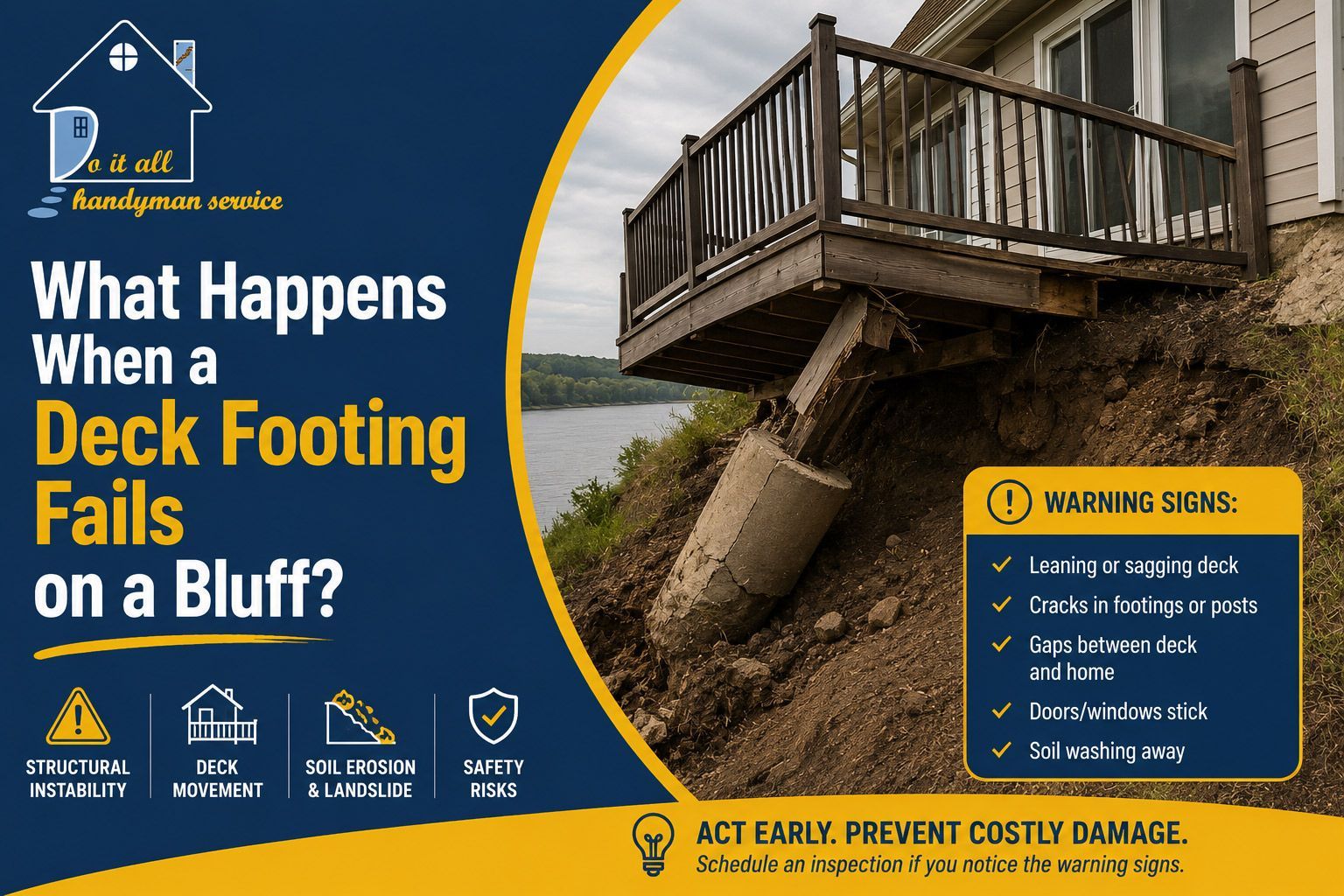
What Happens When a Deck Footing Fails on a Bluff?
The Problem That Starts Small and Gets Expensive Fast
Deck footing failure rarely announces itself. It starts quietly — a post that leans slightly toward the slope, a board that feels different underfoot, a railing that wobbles where it used to hold firm. Homeowners on bluff properties tend to chalk these things up to normal settling, and sometimes they're right. But on terrain above a river or on a steep riverbank grade, those early signals can point to a footing failure that poses real structural risk if it goes unaddressed.
Catching the problem early is the difference between a manageable repair and a dangerous one. In River Falls, WI, where a significant number of homes sit on elevated ground above the St. Croix River, footing failure is a known and well-understood risk — but only correctable if it's recognized in time. Here's what's actually happening beneath the deck, why bluff terrain makes it worse, and what the consequences are when homeowners wait too long.
What a Deck Footing Actually Does
A deck footing is the concrete base that anchors each support post. Its job is to transfer the load of the deck — the weight of the structure itself plus everyone on it — down through the post and into stable soil or bedrock. To do that correctly, the footing needs to be wide enough to distribute the load without sinking, and deep enough to sit below the frost line so seasonal freeze-thaw cycles don't push it out of position.
On flat, stable ground, a correctly poured footing can perform that function for decades without issue. On a bluff or sloped property in River Falls, WI, the conditions are significantly more demanding. Erosion, seasonal water movement, soil saturation, and repeated freeze-thaw stress all act on the ground around the footing in ways that upland soils rarely experience.
When a footing fails, it loses the ability to carry its load correctly. That failure can take several forms: sinking into softened soil, tilting from lateral soil movement, or heaving upward as frost pressure lifts the surrounding ground. Each type produces different visible symptoms at the surface and creates different risks for the structure above.
Why Bluff Properties in River Falls, WI Face Higher Footing Risk
The soil conditions near riverbanks and along bluff faces are fundamentally less stable than upland ground. Several compounding factors make footing failure significantly more likely on these sites.
- Erosion steadily removes soil from around and beneath footings, reducing the lateral support that keeps posts plumb
- Seasonal saturation cycles dramatically lower the load-bearing capacity of riverbank soils, allowing footings to shift under static loads they previously held without movement
- Steep slope angles create lateral forces on footings that flat-ground installations were never designed to resist
- Tree root systems on bluffs expand and contract with the seasons, actively disturbing the soil around footing bases
- Freeze-thaw cycles are more severe in high-moisture soil — the wetter the ground, the more aggressive the heave
- Many bluff decks in the area were built before current codes established stricter footing depth and diameter requirements for sloped and riverfront sites
Footings that met the code when they were poured fifteen or twenty years ago may no longer be adequate given how the terrain has changed. Erosion and soil movement are ongoing processes, and a footing that performed well for the first decade can reach a tipping point as conditions around it gradually shift.
Warning Signs of Footing Failure to Watch For
Most footing failures give visible warning before they reach a critical point. The table below identifies the key indicators and what each one suggests about the condition below.
| Warning Sign | What It Indicates |
|---|---|
| Post leaning toward the slope | Lateral soil movement or erosion has destabilized the footing base |
| Gap opening between deck frame and house ledger | One or more footings have settled or shifted unevenly relative to the ledger connection |
| Decking that was once flat now slopes or dips | Differential settlement — footings have moved at different rates |
| Railing that feels loose or has pulled away from its posts | Post movement has transferred stress upward into railing connections |
| Concrete footing visible above grade | Frost heave has lifted the footing; it's no longer seated at design depth |
| Cracking or spalling concrete at post base | Footing has experienced physical stress — may indicate movement or improper original pour |
| Soil pulled away or eroded from around post bases | Active erosion is removing lateral support from the footing |
Any single sign on this list warrants a professional inspection. Multiple signs appearing at the same time should be treated as urgent — the deck should not be used until it has been evaluated. On a bluff above the river in River Falls, WI, a structurally compromised deck carries consequences that flat-lot failures don't.
What Happens If You Ignore It: A Three-Stage Progression
The consequences of ignoring footing failure don't arrive all at once. They develop in predictable stages, with each stage more expensive and more dangerous than the last.
Stage 1: The Deck Shifts but Stays Functional
In the early stage, the deck remains usable but continues to move. Connections loosen gradually. Fasteners begin pulling away from stressed wood. The cumulative load on connections that were designed for a level, stable structure increases with every cycle of use and seasonal movement. The repair at this stage is targeted and relatively straightforward.
Stage 2: Visible Structural Damage Appears
As movement continues, visible damage becomes pronounced. Boards begin to buckle. Gaps open in the decking surface. Railings pull free from their posts. The structure looks obviously compromised, and at this point the repair scope has expanded beyond the footings themselves — framing and connections that absorbed abnormal stress for an extended period now need assessment and likely replacement.
Stage 3: Collapse Risk
In the late stage, a deck with failed footings becomes a genuine collapse hazard. On a bluff property in River Falls, WI, a partial or full deck failure is a serious safety event — and a homeowner who was aware of the warning signs and chose not to act carries significant liability exposure. Insurance claims for structural failures resulting from deferred maintenance are complicated and frequently contested. The cost of a post-collapse reconstruction is a fraction of what the original repair would have been — plus everything that comes with the safety and liability risk.
Frequently Asked Questions
Can failed footings be replaced without rebuilding the whole deck?
Often yes, if the damage is limited to the footings and the framing above is still structurally sound. Replacing or supplementing failed footings while preserving the existing structure is a targeted repair that many riverfront decks are good candidates for. If the footing failure has caused secondary framing damage, the scope expands accordingly.
How deep do footings need to be on a bluff property in Wisconsin?
Wisconsin's standard frost depth requirement is 48 inches, but bluff sites often require deeper placement depending on soil bearing capacity and erosion history. In cases where stable soil is unreachable at a reasonable excavation depth, helical pier systems that drive to bearing are the more reliable solution. A contractor with genuine bluff experience will know the difference.
What makes helical piers a better choice than poured concrete on some bluff sites?
Helical piers are installed by driving rather than excavating and pouring, which minimizes soil disturbance on a site that's already sensitive. They also reach predictable bearing capacity at depth and can be load-tested during installation. On saturated or erosion-prone sites, they're frequently the more dependable long-term choice.
Does a footing repair in River Falls, WI require a permit?
Structural repairs to deck footings typically require a permit in Wisconsin municipalities. Unpermitted structural work creates problems at resale and can void insurance coverage on that portion of the structure. Confirm requirements with your contractor before work begins — not after.
How often should bluff deck footings be inspected?
A visual inspection every spring — looking for the signs described above — is a reasonable baseline for any bluff deck owner. A professional inspection every three to five years, or after any major weather event involving heavy rain or flooding, provides more confidence about what's happening below the surface. The cost of early detection is always smaller than what deferred awareness produces.
Conclusion
Footing failure on a bluff deck is a predictable risk, not a random one. The terrain conditions along the St. Croix River in River Falls, WI create ongoing stress on deck foundations, and the consequences of ignoring early warning signs run from costly structural repairs to genuine safety hazards. Do It All Handyman Services has direct experience rebuilding and reinforcing deck foundations on exactly this kind of terrain — slopes and bluffs where standard footing approaches don't apply. If your deck is showing any of the signs described here, reach out before the problem outpaces the repair.