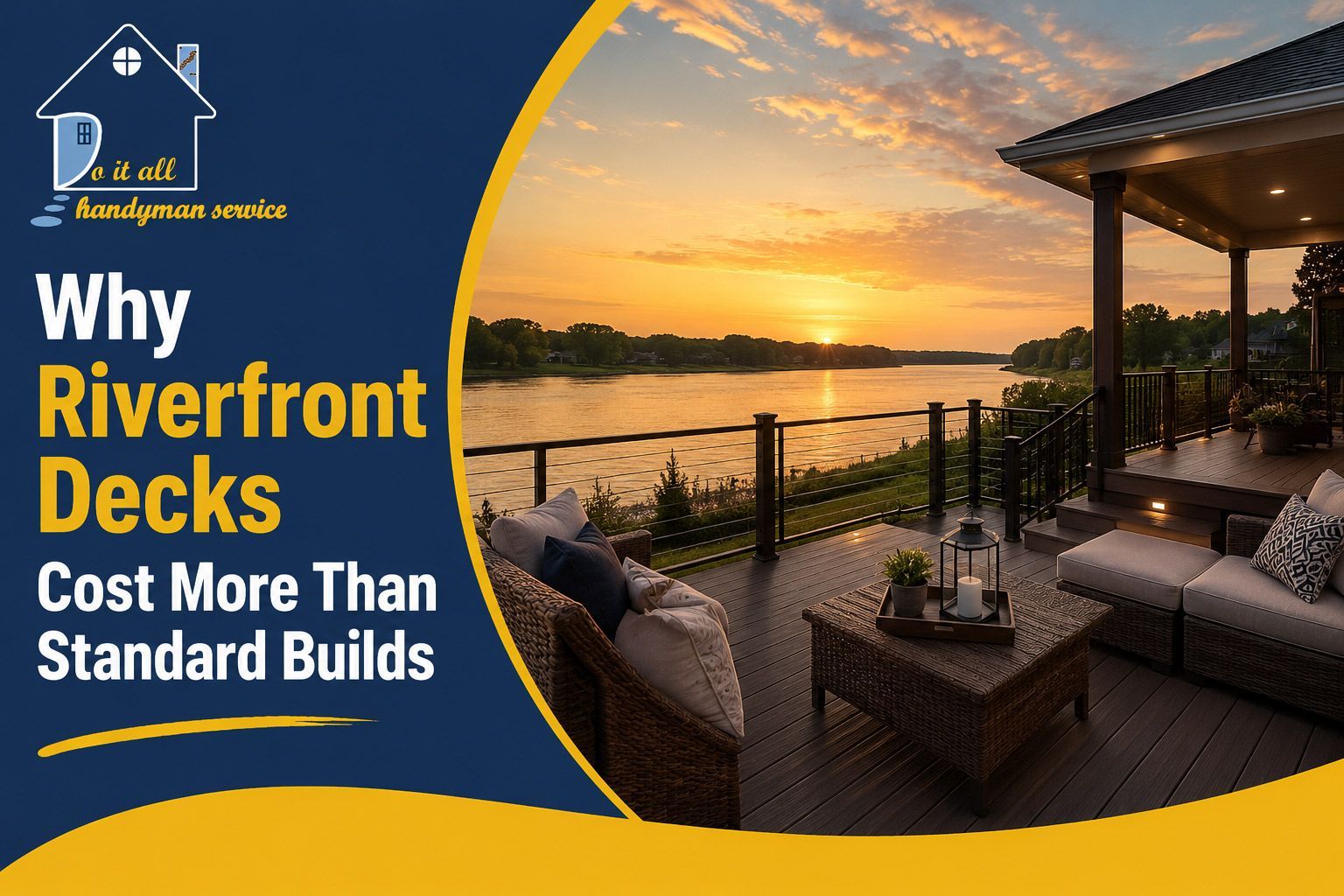
Why Riverfront Decks Cost More Than Standard Builds
The Price Gap Is Real — Here's What's Behind It
If you've gotten a quote for a riverfront deck and felt surprised by the number, you're not alone. Homeowners along the St. Croix River regularly find that their project costs significantly more than a similar-sized deck on a flat residential lot — even when the dimensions and materials look alike on paper. The difference isn't padding. It's the genuine complexity that comes with building on bluffs, riverbanks, and slopes where every phase of construction works against you.
Understanding what drives those costs helps you evaluate bids accurately, set realistic expectations, and make confident decisions before work begins. River Falls, WI sits in a stretch of river corridor where bluff terrain is among the most technically demanding in the state. Here's a plain-language breakdown of what you're actually paying for.
Site Access: Why Moving Materials Costs More Than You'd Expect
On a typical suburban lot, a crew backs a truck to the work area, unloads, and gets started. On a riverfront property in River Falls, WI, that sequence often isn't available. Steep bluffs, narrow stairways, and terrain without road access mean workers hand-carry lumber, hardware, concrete, and equipment down grades no machine can safely navigate.
The labor math adds up fast. A pallet of pressure-treated posts that takes thirty minutes to stage on a flat lot might take two hours to get into position on a bluff. Multiply that across every material delivery and every phase of the project, and the site-access premium becomes one of the single largest cost drivers on riverfront builds.
Equipment that would normally speed up a standard deck project — compact loaders, powered augers, material lifts — is often unusable on bluff sites due to weight limits, slope angles, and access constraints. Manual methods are slower and more labor-intensive. A contractor who doesn't account for that in their estimate will find a reason to adjust the number after signing.
Footings: Why Bluff Soil Demands More Engineering
Every deck rests on its footings. On a standard lot, a footing means digging below frost depth, pouring concrete, and setting a post base. On a riverfront site in River Falls, WI, the soil conditions are fundamentally different — and the footing design has to reflect that.
Riverbanks erode. Soil near water saturates and drains seasonally in ways that shift its load-bearing capacity. The freeze-thaw cycle is more extreme when the ground stays wetter longer. Footings that would be perfectly adequate on stable upland soil may need to go deeper, use larger diameter, or be replaced entirely with helical pier systems that reach stable substrate well below the disturbed surface zone.
Some projects along the St. Croix corridor require engineered drawings before the permit is issued — especially for cantilevered structures or decks attached to homes on high-erosion slopes. That engineering fee appears in the estimate and should. It's what guarantees the structure is designed for the actual conditions of your site, not assumed ones.
Material Selection: What Holds Up in a Riverfront Environment
The environment near a river accelerates deterioration in ways that standard residential settings don't. Higher sustained moisture, direct runoff exposure, and wider temperature swings all reduce the lifespan of lower-grade materials. The table below shows how common material choices compare for riverfront deck applications.
| Material | Performance in Wet Conditions | Relative Cost |
|---|---|---|
| Standard pressure-treated lumber | Acceptable — requires correct retention level for ground contact | Lowest |
| Premium PT (UC4B/UC4C rated) | Better — rated for high-moisture and ground-contact exposure | Moderate |
| Cedar or redwood | Good above grade — not ideal for posts or ground contact | Moderate-High |
| Composite decking | Excellent — resists moisture, no rot, low maintenance | Higher upfront |
| Standard galvanized hardware | Fair — can corrode within a few seasons in wet environments | Lowest |
| Stainless steel or hot-dipped hardware | Excellent — required by code in some waterfront applications | Higher |
Choosing the right material isn't just a quality preference — it's a durability decision. Composite decking costs more upfront than pressure-treated wood, but the maintenance savings over ten to fifteen years often close that gap. The correct fastener choice costs a few hundred dollars more than standard hardware and prevents a replacement job that costs thousands.
Permits and Inspections for Riverfront Builds in River Falls, WI
Building close to a waterway in Wisconsin triggers regulatory requirements that go well beyond a standard residential building permit. These layers add time, documentation, and cost to the project — and they exist whether a contractor accounts for them in the estimate or not.
Shoreland Zoning and Setback Requirements
Most Wisconsin counties enforce shoreland zoning rules that establish minimum setbacks from the ordinary high-water mark. What can be built, and where on the lot it can be placed, is regulated. These rules can directly affect deck size, location, and configuration. A contractor unfamiliar with local shoreland requirements may design a structure that doesn't pass the permit review.
Bluff Impact Zone Regulations
Many municipalities along the St. Croix River corridor define bluff impact zones — areas near the top and face of a bluff where construction is restricted or requires special approval. If your deck falls within that zone, additional documentation and potentially a variance hearing may be required before permits are issued.
Multi-Phase Inspections
Riverfront permits often require inspection at multiple stages: before concrete is poured into footing excavations, before framing is covered with decking, and a final inspection before the deck is approved for use. Each inspection requires scheduling and coordination, which adds administrative work that a standard deck permit doesn't require.
Frequently Asked Questions
Is composite decking always worth the extra cost on a riverfront property?
For most riverfront homeowners, yes. Composite eliminates the annual maintenance cycle of cleaning, staining, and sealing that wood requires — and that maintenance is harder to skip in a high-moisture environment where neglect shows up faster. The long-term cost of ownership often favors composite even when the upfront cost is higher.
Do I need a structural engineer for my riverfront deck project?
Not automatically, but more often than homeowners expect. Cantilevered structures, decks on high-erosion slopes, and projects where the soil bearing capacity is uncertain frequently trigger an engineering review requirement during the permit process. Your contractor should flag this possibility during the estimate conversation, before drawings are submitted.
What happens if a contractor uses the wrong footing design for a bluff site?
The results range from gradual settlement and tilting to outright footing failure — which creates structural risk and expensive remediation. On a bluff above the river, a failed footing isn't just a repair problem. It's a safety hazard. Selecting a contractor with demonstrated riverfront experience is the most direct way to avoid this outcome.
How does the freeze-thaw cycle affect a riverfront deck differently than a standard one?
Wetter soil freezes and expands more aggressively than dry upland soil. Near a river where ground moisture is consistently high, freeze-thaw cycles put more stress on footings and posts with each passing winter. Footings designed for average conditions — not the elevated moisture levels of a riverfront site — are more likely to heave and shift over time.
What questions should I ask before hiring a contractor for riverfront deck work?
Ask how many riverfront or bluff-specific projects they've completed in the last three years. Ask how they handle material delivery on sites without equipment access. Ask whether they've worked within shoreland zoning requirements in St. Croix County. Those questions quickly distinguish contractors with real riverfront experience from those who are adapting a standard approach on the fly.
Conclusion
Riverfront decks cost more because they demand more at every stage — more careful engineering, more demanding material specifications, more regulatory navigation, and more physical labor in difficult conditions. That's not a reason to avoid the project. It's a reason to hire a contractor who has actually done this kind of work before. Do It All Handyman Services has spent years building and repairing decks on bluff and riverfront terrain along the St. Croix River in River Falls, WI. If your property presents the kind of challenges described here, reach out for a free estimate from a team that knows exactly what the work involves.